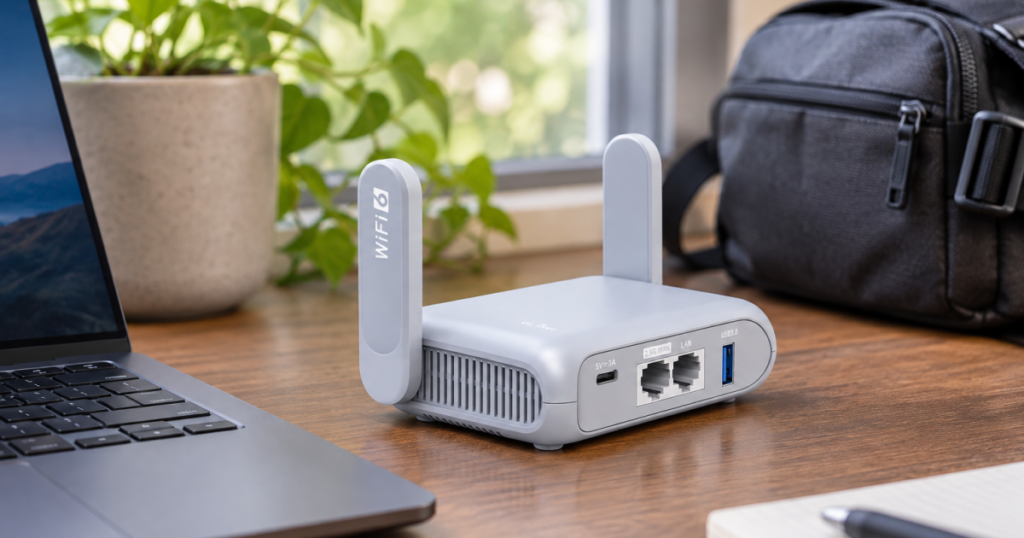
Hotel Wi-Fi is rarely the whole story when you are trying to take calls, run a laptop, keep a tablet connected, and avoid reconfiguring every device in your bag. This GL.iNet Beryl AX (GL-MT3000) review looks at the travel router as a small networking control point for temporary desks, not as a magic fix for bad internet.
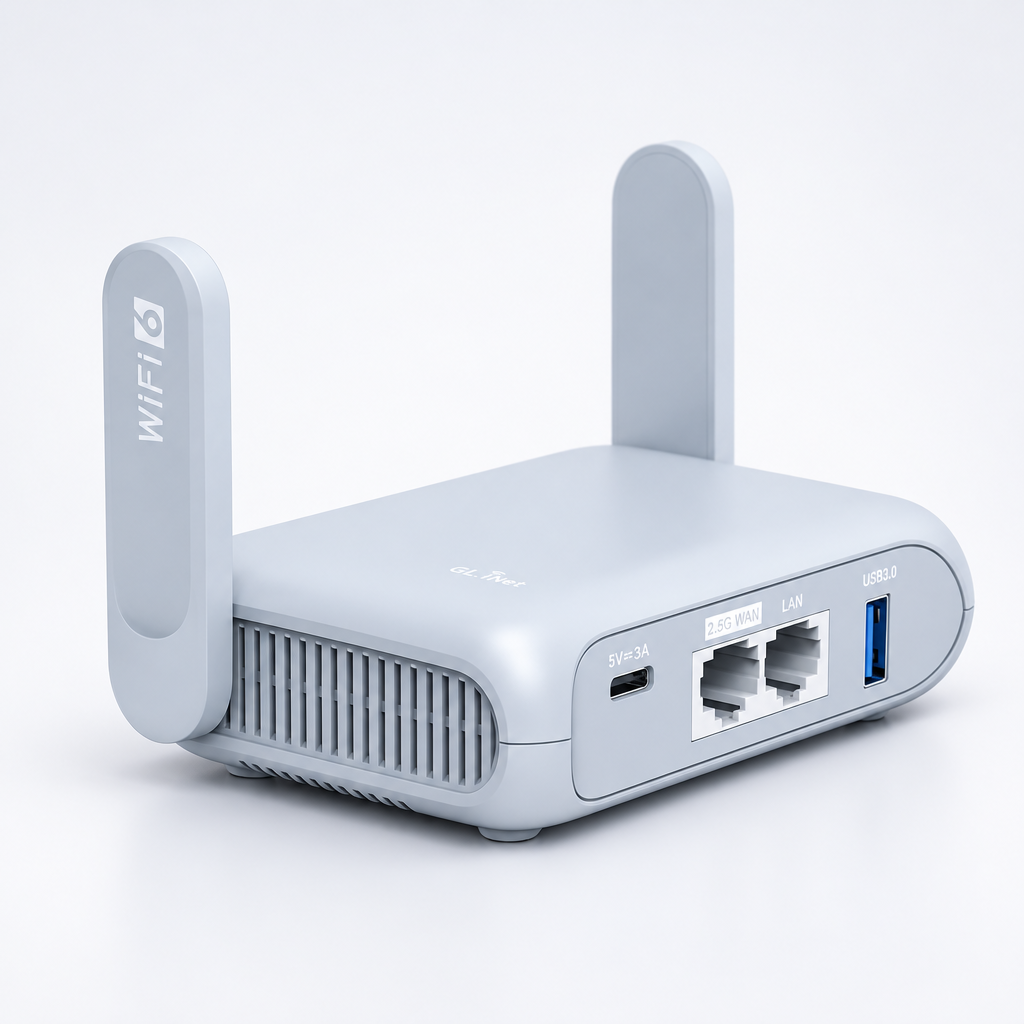
GL.iNet Beryl AX (GL-MT3000)
A strong fit for travelers who want one controlled local network across hotels, rentals, and backup connections
The GL.iNet Beryl AX, model code GL-MT3000, is a pocket-sized AX3000 Wi-Fi 6 travel router. Its job is to create your own local wired or Wi-Fi network, then connect that network to upstream internet through Ethernet, repeater Wi-Fi, USB tethering, or a USB cellular modem. That makes it most interesting for work travelers who already think in backups: hotel connection first, phone tethering when needed, and a cleaner device setup across the whole trip.
Pros & Cons
Pros
- Creates a flexible travel network from Ethernet, repeater Wi-Fi, USB tethering, or cellular sources.
- Modern Wi-Fi 6 spec with rated 2.4 GHz and 5 GHz speeds for current laptops and phones.
- Useful wired layout with a 2.5GbE-rated WAN port and Gigabit-rated LAN port.
- Compact enough for a travel tech pouch at about 4.7 x 3.3 x 1.3 inches and 6.9 ounces.
Cons
- Not a cellular hotspot by itself; mobile internet needs tethering or a compatible USB modem.
- VPN speeds are official local-network client-mode figures, not guaranteed real-world throughput.
- Default firmware does not support EAP network repeating for managed enterprise-style Wi-Fi.
Product Details
- Product: GL.iNet Beryl AX (GL-MT3000), a pocket-sized AX3000 Wi-Fi 6 travel router.
- US direct price listed: $98.99.
- Wireless protocol: IEEE 802.11a/b/g/n/ac/ax, including Wi-Fi 6.
- Rated Wi-Fi speed: 574 Mbps on 2.4 GHz and 2402 Mbps on 5 GHz.
- Ethernet: one WAN Ethernet port rated at 10/100/1000/2500 Mbps and one LAN Ethernet port rated at 10/100/1000 Mbps.
- Ports and controls: one USB 3.0 port, one Type-C power input, reset button, and toggle button.
- Processor, memory, and storage: MT7981B dual-core processor at 1.3 GHz, DDR4 512 MB memory, and NAND Flash 256 MB storage.
- Size and weight: about 4.7 x 3.3 x 1.3 inches and 6.9 ounces.
- Power and environment: Type-C 5V/3A input, power consumption under 8 W, and operating temperature from 32°F to 104°F.
The real appeal: one travel network instead of device-by-device chaos
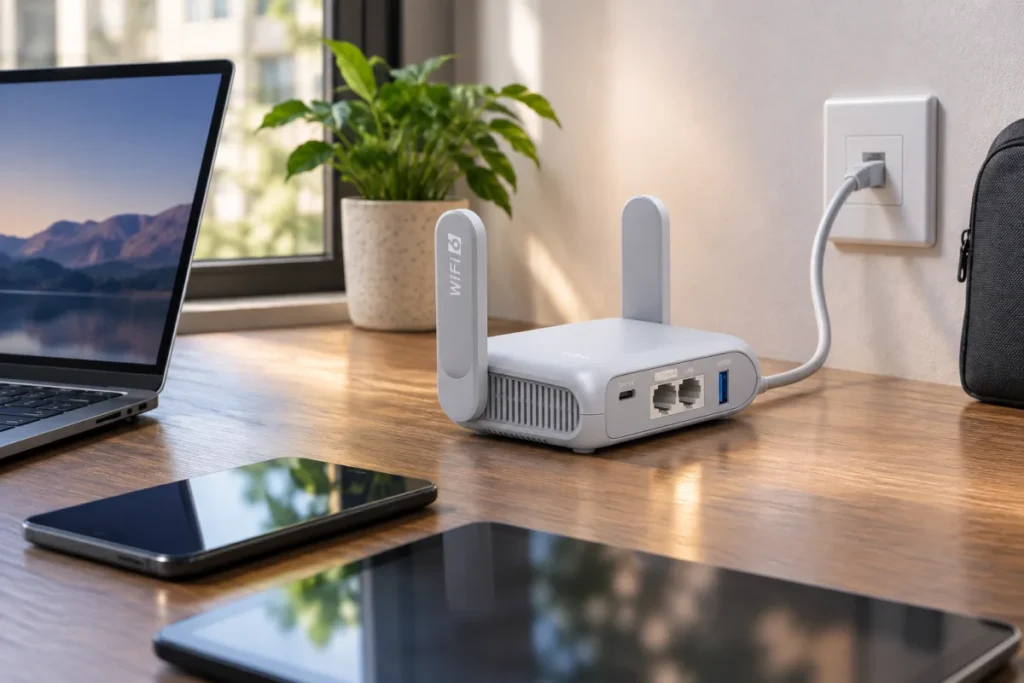
The Beryl AX is not just another gadget for people who like tidy tech pouches. Its practical value is that it can sit between your devices and whatever internet source the room, coworking desk, or rental gives you. Once your laptop, phone, tablet, and small work accessories know your Beryl AX network, the upstream side can change without rebuilding your whole setup every time.
That matters on trips where you move between a hotel room, conference venue, airport lounge, and short-term rental in the same week. The router supports Ethernet, repeater Wi-Fi, tethering, and cellular connection methods, with Multi-WAN available when more than one internet connection is present. The important detail is the phrase “more than one.” Multi-WAN is not a hidden source of internet; it depends on you having multiple upstream paths ready.
For travel work, that makes the Beryl AX a strong fit if your setup already includes a realistic backup connection. If you are deciding whether your phone should be that backup or whether you need dedicated mobile gear, the trade-off is worth thinking through before buying a router. For a deeper split between those two paths, read our guide to dual-SIM phones versus pocket Wi-Fi for work calls.
Wi-Fi 6 and ports: why the specs matter on a temporary desk
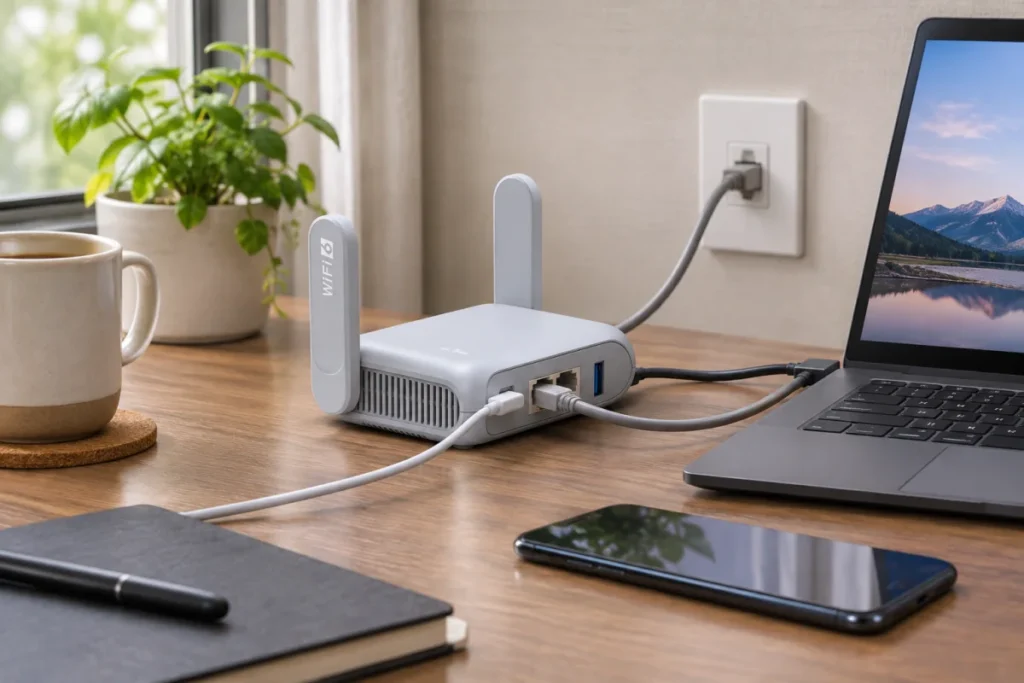
The official wireless rating is AX3000, with 574 Mbps on 2.4 GHz and 2402 Mbps on 5 GHz. Those are rated figures, not a promise that a hotel network will suddenly deliver that speed. In practice, the upstream connection, building layout, client devices, interference, and any network login flow will shape the real experience.
The stronger buying signal is flexibility. Wi-Fi 6 gives the Beryl AX a modern wireless baseline for recent laptops and phones, while the wired ports let you use Ethernet when the temporary workspace provides it. The WAN port is rated up to 2500 Mbps, and the LAN port is rated up to 1000 Mbps. For a work traveler, that means the router is not limited to Wi-Fi repeating; it can also act as a small wired hub between a room’s Ethernet and your laptop or travel setup.
That distinction matters because Ethernet, when available, removes one variable from the day. A wired upstream connection can reduce the number of things competing in the air, while a local Wi-Fi network from the Beryl AX can still serve your other devices. This does not guarantee call quality, but it gives you more ways to build a stable work path than relying only on the laptop’s connection to a crowded access point.
VPN capability is useful, but the numbers need context
GL.iNet rates VPN throughput at up to 150 Mbps for OpenVPN and up to 300 Mbps for WireGuard, and those figures are client-mode local-network test values. That makes WireGuard the more interesting protocol on paper for travelers who route work traffic through a VPN service or a self-hosted VPN server.
The caveat is important: real-world VPN speed depends on network configuration, server choice, upstream bandwidth, protocol overhead, and whether you are using client or server mode. Server mode is documented as slower. So the right way to read the VPN spec is not “this will make every connection fast.” It is “this router has documented VPN client/server capability with official throughput ratings that are plausible for serious travel use when the rest of the network path supports it.”
For sensitive work, your employer’s approved security practices still govern what you should use. The Beryl AX can be part of a cleaner travel network, but it does not replace workplace policy, managed devices, or approved access methods.
Power and packability are the travel-friendly parts
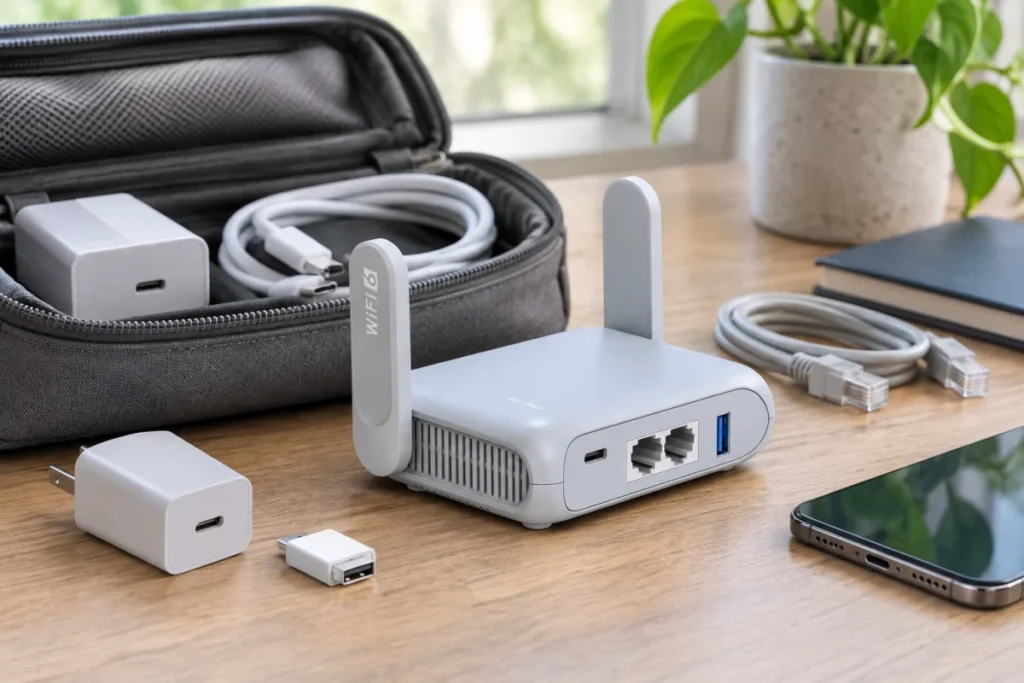
At about 4.7 x 3.3 x 1.3 inches and 6.9 ounces, the Beryl AX is small enough to make sense in a tech pouch rather than demanding its own packing plan. It uses Type-C power input at 5V/3A, with power consumption under 8 W. That is exactly the kind of low-draw accessory that can share desk power planning with your laptop charger, phone, and display setup.
It still needs power. This is not a battery-powered hotspot, and it does not include an internal cellular modem. If you want cellular internet, you need a compatible USB modem or a tethered device, plus external power for the router. That is not a flaw; it is the product category. But it changes the buying decision. Travelers who want one always-on mobile-internet box with its own cellular hardware should look at cellular travel routers instead.
For outlet-starved desks, the Beryl AX pairs best with a power plan that is already simplified. If your laptop, phone, and router are all fighting for separate bricks, the setup becomes less elegant. A compact multiport charger can help consolidate the power side; our Anker Prime Charger 100W review is a useful reference point for thinking through USB-C port allocation on travel workdays.
The limitation that can change the decision: EAP repeating
The most important compatibility limitation is not speed. It is network type. EAP network repeating is not supported on the default firmware for the GL-MT3000; GL.iNet says OpenWrt firmware with EAP support is needed. For many travelers, that will not matter on basic hotel or rental networks. For campus, enterprise, or some managed hotel environments using WPA-Enterprise/EAP, it can matter a lot.
This is where the Beryl AX is better framed as a capable travel router than as a universal network skeleton key. If your trips regularly involve enterprise-managed Wi-Fi, university networks, or strict conference infrastructure, the default-firmware limitation deserves real weight. A router that works brilliantly in one hotel can still be the wrong tool for a network environment it was not set up to repeat.
The work trips where the Beryl AX makes the most sense
The Beryl AX is strongest for travelers who want repeatable setup logic: one known local network, multiple upstream options, and VPN features in a compact device. Consultants, creators, and remote employees who move between short stays can use that structure to reduce friction. Your devices connect to the same router; the router adapts to the room, cable, phone tether, or USB modem available that day.
It is less compelling if your travel pattern is casual laptop use with no calls, no second device, and no need for a controlled local network. In that case, a phone hotspot may be simpler. It is also the wrong expectation if you want rugged outdoor deployment. The documented operating temperature range is 32°F to 104°F, and the product should not be treated as a hardened field router.
When Wi-Fi 7, more physical ports, or higher VPN throughput are priorities, GL.iNet’s newer Beryl 7 or Slate-series travel routers are the natural comparison points. The Beryl AX remains the cleaner choice when you want a compact Wi-Fi 6 travel router with useful upstream flexibility at a listed direct price under $100.
Value at $98.99
At $98.99 direct, the Beryl AX sits in a sweet spot for a serious travel-work accessory: not cheap enough to buy casually, but reasonable if it prevents repeated network friction across trips. The value is strongest when you will actually use more than one of its core abilities: Ethernet when available, repeater Wi-Fi when necessary, tethering or cellular USB when planned, and VPN client features where your workflow calls for them.
If you would only use it as a basic Wi-Fi repeater once or twice a year, the value drops. If you routinely arrive at a desk and immediately assess outlets, Ethernet, upload reliability, call timing, and fallback paths, it earns its space much faster. This is the kind of small box that rewards planning rather than improvisation.
Verdict
Score: 8.7/10. The GL.iNet Beryl AX is a highly recommendable travel router for remote workers who want a compact way to organize messy temporary networks. The score is driven most by its flexible upstream connection methods, modern Wi-Fi 6 specification, useful wired-port layout, and travel-friendly size.
The main compromises are equally clear: it needs an upstream internet source, cellular use requires tethering or an external USB modem, VPN throughput depends on the wider network path, and default-firmware EAP repeating is a real limitation for some managed networks. For hotel rooms, rentals, coworking desks, and trips where you bring a deliberate backup connection, it is a smart, confidence-building addition to a mobile work kit.
GL.iNet Beryl AX (GL-MT3000)
A strong fit for travelers who want one controlled local network across hotels, rentals, and backup connections
You might also like: How to Set Up a Laptop Stand on a Tiny Hotel Desk.