One-bag travel gets harder when the bag has to carry clothes, cables, a laptop, and enough structure to make a hotel desk feel less improvised. This Patagonia Black Hole® Mini MLC® Pack 30L review focuses on whether Patagonia’s 30-liter convertible carry-on laptop backpack makes sense for remote-work trips where pack volume, laptop access, and carry flexibility are all part of the same decision.
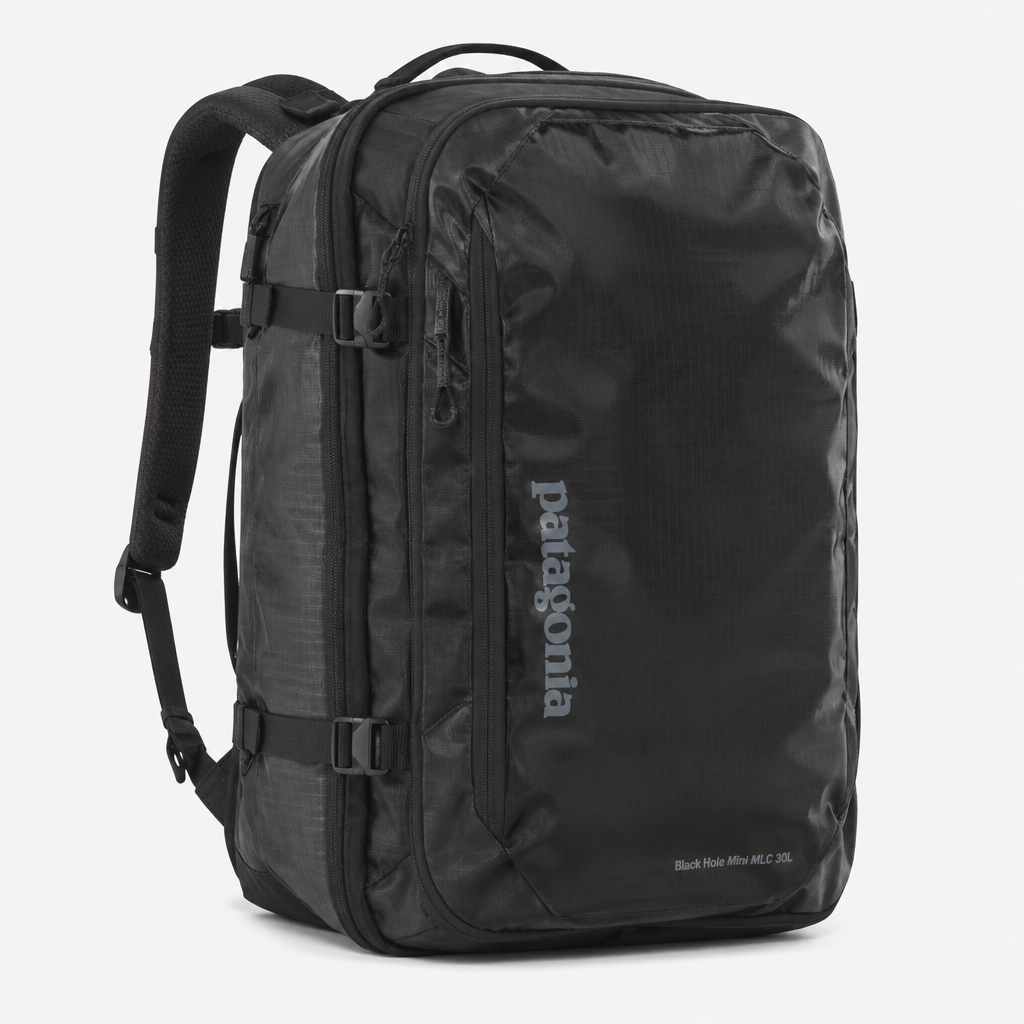
Patagonia Black Hole® Mini MLC® Pack 30L
A strong one-bag work option when 30 liters, laptop access, and flexible carry modes match the trip
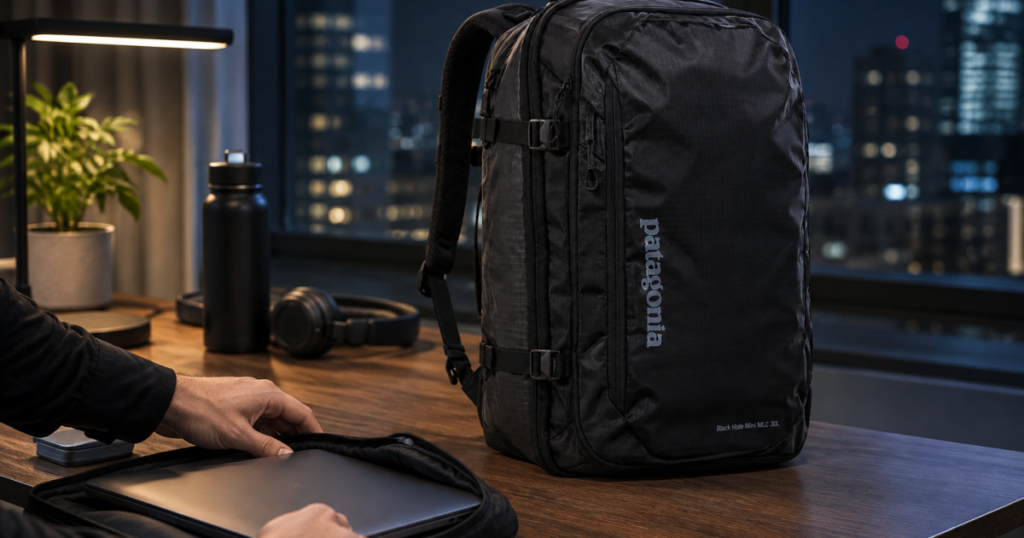
The Patagonia Black Hole® Mini MLC® Pack 30L, Style No. 49266, is a soft-sided travel pack with dedicated tech storage and three carry configurations: backpack, shoulder/cross-body bag, and duffel/briefcase. At $199, it sits in the serious travel-work bag zone: not a casual daypack, not a wheeled suitcase, and not a full-size replacement for travelers who need substantially more capacity.
Patagonia Black Hole® Mini MLC® Pack 30L
Pros & Cons
Pros
- 30-liter capacity gives the pack a useful middle lane for short work trips and disciplined one-bag travel.
- Dedicated tech storage fits most 15-inch laptops and lies flat for TSA-oriented airport flow.
- Backpack, shoulder/cross-body, and duffel/briefcase modes make the carry setup more adaptable.
- Large main compartment plus two interior pockets keeps organization helpful without overcomplicating the bag.
Cons
- Laptop fit is stated for most 15-inch laptops, so larger workstation-style machines are not the natural match.
- Carry-on fit still depends on carrier and route enforcement, despite the travel-friendly dimensions.
- No waterproof, submersion, or IP rating is stated for electronics-heavy packing in severe wet conditions.
Product Details
- Capacity: 30 liters.
- Dimensions: 20 x 12 x 7 in.
- Weight: 2 lb 13.5 oz.
- Price: $199.
- Laptop storage: dedicated tech storage fits most 15-inch laptops and lies flat for TSA compliance.
- Carry configurations: backpack, shoulder/cross-body bag, and duffel/briefcase.
- Organization: large main compartment with two interior organization pockets and an exterior stretch-mesh water-bottle pocket.
- Body fabric: 8.7-oz 300-denier 100% postconsumer recycled polyester ripstop with postindustrial recycled TPU-film laminate.
- Country of origin: Vietnam.
- Warranty statement: “We guarantee everything we make.”
The 30-liter size is the whole argument
The most important number here is not the price, the material, or even the laptop fit. It is 30 liters. That capacity puts the Patagonia Black Hole® Mini MLC® Pack 30L in a useful middle lane for mobile work: bigger than a commuter backpack, smaller than a larger travel suitcase, and structured around carrying work gear alongside clothes.
For a short business trip, conference run, or long weekend with serious work blocks, 30 liters can be a practical target. It encourages a tighter packing plan: laptop, charger, cable pouch, one compact work accessory layer, and a disciplined clothing load. It is not the right framing if the goal is to bring a bulky office, multiple spare shoes, and every “just in case” item. The pack rewards editing.
The listed dimensions, 20 x 12 x 7 in, also explain the role. This is a carry-on-oriented soft bag, not a rigid spinner and not a tiny underseat-first personal item. Patagonia describes it as meeting tighter carry-on requirements, but airline enforcement varies by carrier and route. The safer interpretation is that the dimensions are travel-friendly for many carry-on situations, while still depending on the aircraft, fare rules, and how full the pack is.
That is where the Patagonia Black Hole® Mini MLC® Pack 30L fits the mobile-office mindset well. A good travel-work bag is not just a container; it is a constraint system. If you want a broader way to think about building around uncertainty rather than recreating a full home setup, the same logic shows up in designing for uncertainty instead of a mini home desk.
Laptop storage is the clearest work-travel feature
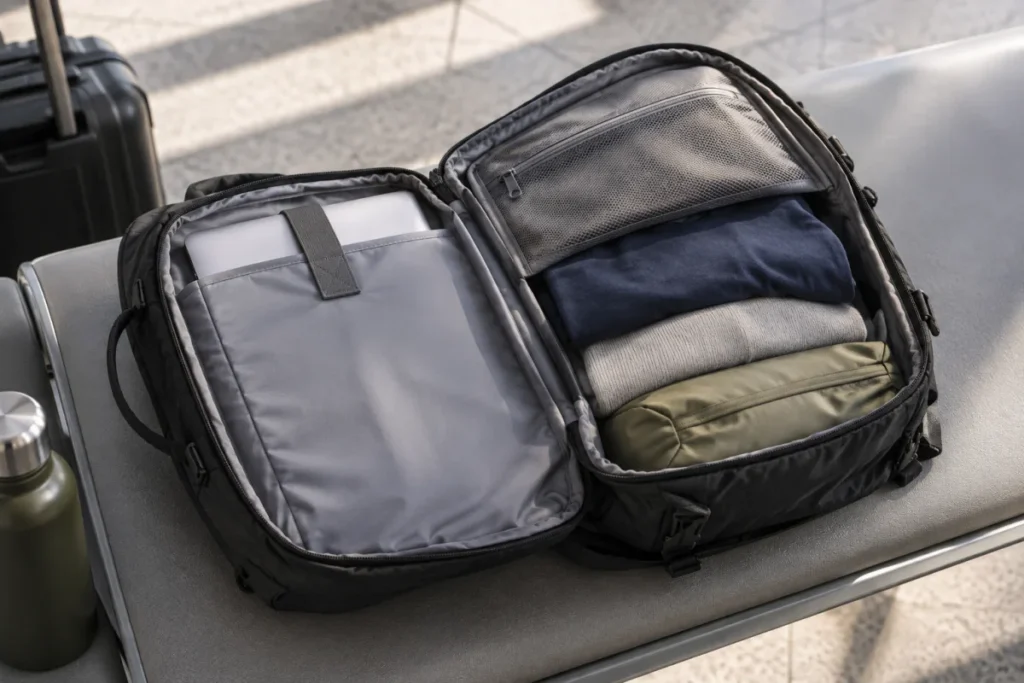
Patagonia states that the dedicated tech storage fits most 15-inch laptops and lies flat for TSA compliance. For travel workers, that is more than a nice compartment note. It changes the arrival and transit rhythm: the laptop has a defined home, and the tech area is not fighting with clothes in the main compartment.
The “most 15-inch laptops” wording deserves careful reading. This is a strong fit signal for many mainstream work laptops, but it is not a promise that every 15-inch machine, thicker workstation laptop, or larger computer will slide in cleanly. If your laptop is unusually large, ruggedized, or closer to a mobile workstation than a slim notebook, the Patagonia Black Hole® Mini MLC® Pack 30L is less automatic than the name might suggest.
The flat-lay TSA-oriented design is also useful because travel work is full of awkward transitions: hotel lobby to rideshare, airport security to gate, gate to plane, plane to rental desk. A bag that keeps the laptop area distinct can make those transitions less chaotic. It will not make security lines pleasant, but a dedicated tech section usually beats excavating a laptop from beneath a packing cube while a line builds behind you.
Convertible carry helps when the day keeps changing
The Patagonia Black Hole® Mini MLC® Pack 30L can be carried as a backpack, shoulder/cross-body bag, or duffel/briefcase. That flexibility is one of its better arguments for work travel because the “right” carry mode changes quickly.
Backpack mode is the most obvious option when you are walking through a terminal, switching trains, or moving with both hands free. Duffel/briefcase carry makes more sense when you want the bag lower-profile in a meeting-adjacent setting or when moving a short distance from rideshare to lobby. Shoulder/cross-body carry adds another option for quick access and short transfers.
There is one design trade-off in the official description: the padded hip belt doubles as the shoulder strap. That keeps the system integrated, but it also means the shoulder strap is not a separate, always-available component while the hip belt is being used as a hip belt. For most urban travel-work days, that is probably a sensible consolidation. For people who rely on both a hip belt and a separate shoulder strap at the same time, it is a constraint.
At 2 lb 13.5 oz empty, this is not an ultralight sack. The weight reflects a more capable travel-laptop layout, convertible carry, and organization. The practical question is whether the carry modes and laptop structure replace another bag or accessory in your kit. If they do, the weight is easier to justify. If you already pack a second laptop bag, tech pouch, and separate shoulder bag, the system can become redundant quickly.
Organization is useful without turning the bag into a filing cabinet
The pocket layout is straightforward: a large main compartment, two interior organization pockets, and an exterior stretch-mesh water-bottle pocket. That is the right level of organization for many one-bag work trips. It gives small items a place to go without dividing the main volume into too many fixed sections.
For remote-work travel, over-organization can be surprisingly annoying. Too many narrow pockets create a guessing game: which zipper has the USB-C cable, which sleeve has the passport, which corner swallowed the earbuds? The Patagonia Black Hole® Mini MLC® Pack 30L seems better suited to a cleaner system: main compartment for clothing and larger items, tech storage for the laptop, interior pockets for small essentials, and the exterior bottle pocket for hydration on the move.
The main compartment is also where packing discipline shows. A compact laptop stand, slim charger, and small cable pouch can coexist with clothes more easily than bulky desk accessories. If your workstation depends on raising a laptop at the destination, pair the bag plan with a compact setup routine like setting up a laptop stand on a tiny hotel desk. The bag gets the kit there; the desk plan decides whether the workday actually feels controlled.
Material, guarantee, and realistic weather expectations
The body fabric is listed as 8.7-oz 300-denier 100% postconsumer recycled polyester ripstop with a postindustrial recycled TPU-film laminate. That is a substantial material description, and it supports the product’s identity as a soft-sided travel pack rather than a basic everyday backpack.
Still, the Patagonia Black Hole® Mini MLC® Pack 30L should not be treated as a waterproof dry bag. The product information does not state a waterproof, submersion, or IP rating. The responsible interpretation is that the material construction is travel-oriented, but the pack should not be relied on as a sealed protection system for electronics in serious weather or wet storage conditions.
Patagonia’s warranty statement, “We guarantee everything we make,” is a meaningful ownership signal. It does not replace careful packing or protect against every travel scenario, but it does give the bag a stronger support backdrop than anonymous luggage. For a work-travel bag that may see airports, overhead bins, hotel floors, and rental entryways, support policy is part of the buying decision.
Where the Patagonia Black Hole® Mini MLC® Pack 30L can feel wrong
This pack makes the most sense when you want one soft-sided 30-liter travel bag with laptop storage and flexible carry. It is less convincing if your trips routinely demand full suitcase volume. Patagonia’s larger Black Hole® MLC® 45L is the more logical comparison for substantially more capacity, while the Black Hole® Micro MLC® 22L or a smaller daypack is a cleaner direction for underseat-first minimal packing.
The other mismatch is laptop size. Because the stated laptop fit is most 15-inch laptops, the Patagonia Black Hole® Mini MLC® Pack 30L is easier to recommend for common business laptops than for larger workstation-class machines. It is also not a hiking-specific pack, a camera bag, a wheeled carry-on, or a rigid protective case. Treating it as any of those will lead to the wrong expectations.
The best use case is the traveler who wants a single organized bag for a few days of work travel, with a laptop, charger, cables, clothing, and a compact desk kit moving together. The pack is less about maximal capacity and more about repeatable transitions: pack, board, arrive, open laptop, set up, work.
Verdict
Score: 9.0/10.
The Patagonia Black Hole® Mini MLC® Pack 30L is strongly recommendable for travel workers who want a 30-liter carry-on-oriented backpack with dedicated laptop storage and multiple carry modes. The score is driven most by the capacity-to-workflow balance, the TSA-flat tech storage for most 15-inch laptops, and the flexible carry design.
The limitations are clear rather than disqualifying. It is not a larger suitcase replacement, not a tiny underseat-first daypack, not a waterproof dry bag, and not a guaranteed fit for every laptop near the 15-inch class. But for a traveler building a compact, repeatable remote-work setup around one soft-sided bag, it is a polished and practical option.
Patagonia Black Hole® Mini MLC® Pack 30L
A strong one-bag work option when 30 liters, laptop access, and flexible carry modes match the trip
You might also like: ASUS ZenScreen Duo OLED MQ149CD Review: Dual OLED Workspace for Travel Work.